A simple visual guide · Free book
Ashtavakra Gita
A simple visual guide to identity, awareness and freedom, with clear explanations and everyday examples.

The thread through the book
A thought, a feeling or a role can become your whole story about yourself. This guide explains how the Ashtavakra Gita questions that story.
Start with something you can recognise
A thought appears. A plan fails. Praise feels good and criticism stings. The guide begins with moments like these, then builds towards the Ashtavakra Gita’s ideas about the self, awareness and freedom. Short explanations and pictures connect one idea to the next.
The text presents Advaita, a philosophy in which reality is ultimately one. The guide explains that view and keeps the text’s teaching, Aravindanji’s interpretation and everyday editorial examples clearly identified.
The collection of 91 lectures reaches chapter 4, verse 3. A separate guide covers all 20 chapters of the text. The lecture summaries follow the recordings, and the text map shows the wider work.
Inside the guide
One idea, made visible.
A short explanation and a picture make each idea easier to follow. Everyday examples connect the teaching with familiar moments.
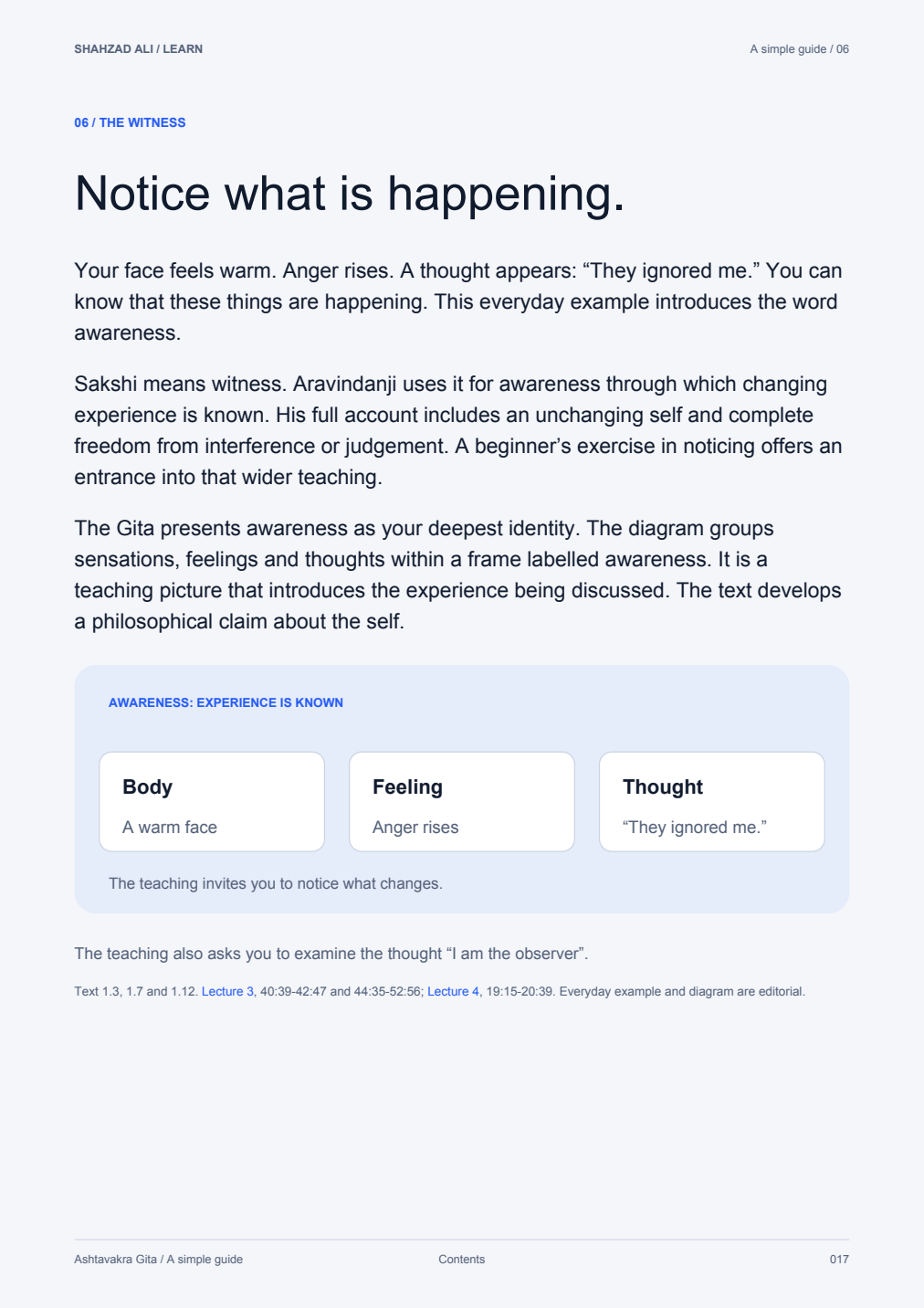
Start with the simple chapters, use the text map to see the whole work, or return to an individual lecture summary.
Read this chapter in the PDF ↗The journey
Three ways to read.
- 01
12 simple chapters
Begin with identity, desire and awareness. Follow the connections through illusion, action, practice and ordinary life.
- 02
A map of all 20 chapters
See the whole text in order, with short summaries, key ideas and verse references.
- 03
91 lecture summaries
Return to Aravindanji’s explanations one lecture at a time, with source timings and everyday examples.
A few pages inside
Three ideas to begin with.
An idea from the guide
A result becomes a story about me
A plan fails. Then a thought appears: “I am a failure.” The first statement describes a result. The second spreads it across your identity. The text’s enquiry into the self begins with noticing the identities we take for granted.
Editorial example introducing the text’s enquiry into identity.
An idea from the guide
A rope mistaken for a snake
In dim light, a rope looks like a snake and fear follows. More light reveals the rope. The teacher uses this mistake to explain an Advaita claim about appearance and reality. The example helps us understand the claim; the larger philosophical argument needs its own examination.
Ashtavakra Gita 1.10; Aravindanji’s lecture 10.
An idea from the guide
Understanding meets ordinary life
You make a mistake at work, acknowledge it and repair what you can. You can also notice the shame or defensiveness that appears. This everyday example connects the text’s opening emphasis on compassion and truthfulness with attention to your reactions.
Editorial example connected with Ashtavakra Gita 1.2.
161 pages of original explanations, diagrams and source references. The 91-lecture collection reaches chapter 4, verse 3; the separate text map covers all 20 chapters.
Sources and credits
The Ashtavakra Gita is traditionally attributed to Ashtavakra. Aravindanji’s lectures inform the lecture summaries and the guide. The separate map of the whole text uses the Sanskrit source and Swami Nityaswarupananda’s reference edition. Explanations and everyday examples use original editorial wording. Claims about the self and ultimate reality are presented as Advaita philosophy.
- Ashtavakra Gita: Sanskrit source ↗
Verse wording and chapter numbering. Sanskrit Documents credits John Richards, Raj Acharya and Rajani Arjun Shankar for transcription and proofreading.
- Ashtavakra Samhita: Swami Nityaswarupananda ↗
Advaita Ashrama, first edition 1940. Reference translation and commentary used to check the text map and selected interpretations.