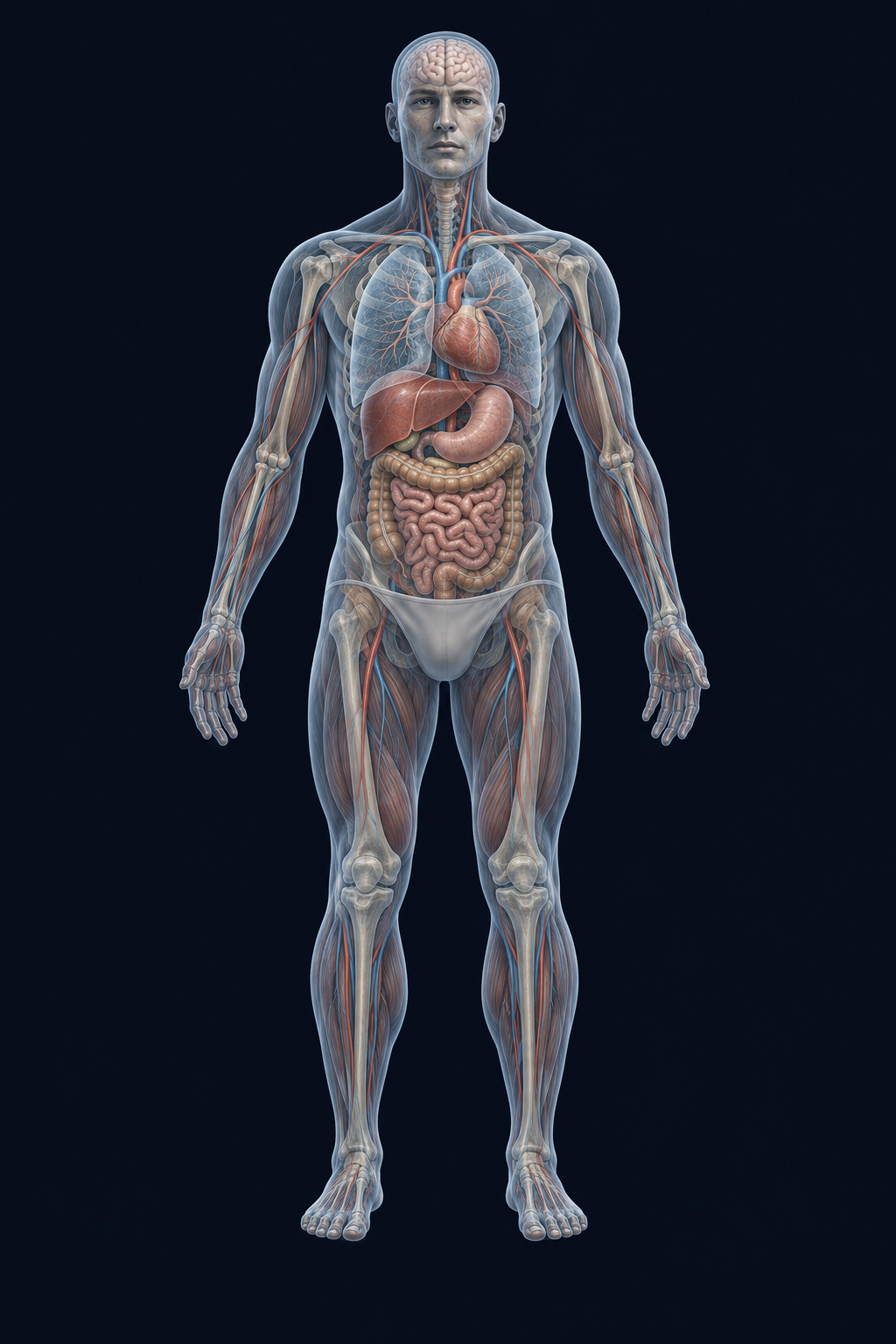
A heartbeat sends blood around the body. The illuminated pathways are a schematic of circulation.
01 / Heart & circulation
Keep the circulation working.
The heart, blood vessels and lungs supply the rest of the body. Fitness, blood pressure and cholesterol all belong in this picture.
Foundations
Foundation
Build aerobic capacity
The adult activity guideline is at least 150 minutes of moderate activity, or 75 minutes of vigorous activity, each week. Brisk walking, cycling and swimming count. Build gradually; an existing heart condition calls for an individual exercise plan.
Blood pressure, cholesterol, smoking, food and activity affect cardiovascular risk. A balanced diet with vegetables, fibre and unsaturated fats belongs alongside any treatment your clinician recommends.
Start with blood pressure, a lipid profile, diabetes risk, waist, weight and family history. Eligible adults aged 40–74 in England are offered an NHS Health Check every five years. Existing conditions often need their own monitoring schedule.
A low-dose CT scan measures calcified plaque in the heart’s arteries. Selective testing can help when a preventive treatment decision remains uncertain. A zero score can still coexist with non-calcified plaque. The scan uses radiation; chest pain needs its own clinical assessment.
Track an activity you can repeat: the same walking route, cycling session or supervised fitness test. Compare effort and recovery under similar conditions. Medical symptoms need clinical assessment.
This prescription medicine is used for erectile dysfunction and symptoms of an enlarged prostate. Observational studies report cardiovascular associations, but general heart-prevention benefit from a daily 5 mg regimen remains unestablished. Nitrates and riociguat must never be combined with tadalafil because blood pressure can fall dangerously.
A deficiency can need treatment. For generally healthy adults without deficiencies, evidence is insufficient to recommend multivitamins to prevent cardiovascular disease. Vitamin E and beta-carotene are specifically discouraged for that purpose.
Prescription omega-3 products have specific clinical uses, including lowering very high triglycerides. Standard fish-oil supplements have different formulations and evidence. Vitamin K2 is being studied, with its effect on arterial calcification and heart disease still uncertain.
Wegovy has a UK indication to reduce major cardiovascular events in adults with established cardiovascular disease and BMI of at least 27. Suitability and access require a clinical assessment. Semaglutide also carries a very rare risk of an eye condition called NAION. Sudden vision loss or rapidly worsening eyesight needs urgent assessment at eye casualty or A&E.
Human clinical evidence is too limited to establish a cardiovascular benefit from taking MOTS-c. Cell and animal findings provide questions for trials; they leave the personal benefit and risk uncertain.
Metabolic health connects body fat, muscle, food, activity and glucose regulation. The useful target is personal and changes with health and body composition.
Foundations
Foundation
Food you can sustain
A varied diet, adequate protein, fibre and regular activity provide the base. Weight management also needs a pattern you can sustain. Resistance exercise helps make strength part of the goal.
Height, waist, muscle, ethnicity and medical history help interpret weight. Being in your 40s alone cannot determine an ideal number. Waist-to-height ratio adds context to BMI.
NICE advises keeping your waist below half your height. Its adult waist-to-height categories are intended for people with BMI below 35. Use consistent measurements to follow the trend.
BMI can misclassify people with high muscle mass. Cardiometabolic risk also occurs at a lower BMI in several ethnic groups, including people of South Asian background. Interpret it alongside other measures.
Semaglutide activates GLP-1 receptors. Tirzepatide acts on GIP and GLP-1 receptors. These prescription treatments can support weight management in eligible people, alongside diet and activity. Side effects and ongoing review matter.
NAION affects the optic nerve and can cause sudden, painless sight loss. The MHRA classifies it as a very rare possible side effect of semaglutide. Its 5 February 2026 notice advises urgent eye casualty or A&E assessment for sudden vision loss or rapidly worsening eyesight. This review covered semaglutide medicines.
Retatrutide is being studied as a treatment acting on GLP-1, GIP and glucagon receptors. It remains an investigational drug. The FDA states that it is unapproved and cannot be used in compounding under US federal law.
Keep a simple record of movements, repetitions and how they feel. Compare the same task over time. Technique, comfort and consistency belong beside the amount lifted.
Body mass can change with fat, muscle and water. Creatine can increase water retention, so a higher scale reading needs interpretation alongside waist and performance.
Creatine helps replenish ATP during brief, demanding efforts. Research supports improvements in repeated high-intensity exercise and training capacity. The evidence is strongest for this performance use.
Protein supports muscle repair and adaptation. Vitamin D supports bones and muscles; UK advice includes considering a supplement in autumn and winter. Individual needs depend on diet, sun exposure and health.
GH replacement has a clinical role in diagnosed adult growth hormone deficiency. Anti-ageing use has a different evidence base, with uncertain benefit and potential harm. Specialist assessment is essential.
Hormones carry signals between organs. Symptoms, repeat measurements and clinical context help explain whether a signal needs treatment.
Foundations
Foundation
Start with symptoms
Persistent changes in libido, energy or sexual function deserve a clinical conversation. Sleep, illness and other conditions can affect how you feel. An assessment helps identify the cause.
Consistent sleep, activity and weight management belong in a hormone-health discussion. Replacement treatment needs a defined indication and a monitoring plan.
Testing is guided by symptoms and clinical context. Diagnosis requires relevant symptoms plus consistently low testosterone, confirmed with two separate morning, fasting measurements. Routine screening of all men is discouraged; a clinician can investigate the cause of a low result.
Monitoring includes symptom response and adverse effects. Blood count, prostate assessment where appropriate, sleep apnoea and fertility plans can affect decisions about testosterone therapy.
Researchers followed 1,156 men, aged 40–70 at recruitment, for 7–10 years. The average decline in total testosterone was around 1.6% per year. Health changes and individual variation matter.
Illustration using the cohort’s average rate: 100 × 0.984years. Each person’s course differs. This graph provides context; symptoms and repeat blood tests guide diagnosis.
TRT can treat confirmed hypogonadism. Starting it requires an individual benefit-risk discussion. It can suppress fertility; elevated haematocrit and certain medical conditions are important considerations.
The TRAVERSE trial assessed cardiovascular safety in men with symptoms, confirmed low testosterone and existing or elevated cardiovascular risk. It does not establish a heart-prevention use. Testosterone treatment can raise blood pressure and needs monitoring.
FDA requested removal of the age-related limitation and changes to prostate safety wording. The displayed AndroGel label still carries earlier wording and blood-pressure warnings. Product-specific implementation and UK prescribing information need separate checks.
Hormone levels change with age. Treatment decisions depend on a diagnosed condition and evidence for the intended outcome. Being in your 40s alone does not establish an indication.
A personal experiment: clear the desk, prepare what the next task needs and reduce avoidable interruptions. Notice whether your attention improves. Keep the changes that help.
What to measure
Measurement
Follow function
A useful personal log can record sleep, concentration and the work you actually completed. Patterns create better questions for a clinical assessment when difficulties persist.
Changing several things together makes the cause of a change difficult to identify. A clear question and a consistent observation are a starting point for learning about yourself.
Semax is a synthetic peptide studied for neurological uses. FDA reviewers describe substantial limitations in the clinical evidence. Benefits and safety for improving focus in healthy people remain uncertain.
Selank is a synthetic peptide investigated for anxiety-related effects. FDA safety information highlights missing human safety data and potential immune reactions associated with peptide impurities or aggregation.
Sleep creates the conditions for tomorrow. A dark room, a repeatable routine and attention to how you feel are useful places to start.
Foundations
Foundation
Time, darkness & consistency
Most adults need 7–9 hours of sleep. Keep a regular wake time and allow time to wind down. A quiet, dark, cool room helps; an eye mask can reduce unwanted light.
Heart rate variability describes differences in time between beats. It varies with age, fitness and other factors. Follow your usual pattern with the same device and measurement conditions; a universal ideal HRV number would be misleading.
Read a recovery trend alongside sleep duration, illness, training and daytime function. Consumer wearables offer estimates. Symptoms and persistent changes may need clinical assessment.
A 2025 trial in 155 adults with poor sleep found a small improvement in insomnia symptoms over four weeks. Results were questionnaire-based and longer-term benefit remains uncertain. Consider intake, kidney function and medicine interactions before supplementing.
Treatment may include cognitive behavioural therapy for insomnia. A GP can help identify causes and suitable treatment when sleep problems continue or affect daily life.
NAD, mitochondria and cellular signalling are fascinating areas of research. A change in a blood marker is one step in a much longer question about health.
Foundations
Foundation
Keep the useful inputs
Activity, adequate nutrition and sleep already have a place in day-to-day health. They remain relevant while researchers investigate new ways to influence cellular function.
A study can measure a molecule, physical function, symptoms or disease outcomes. Each result answers a different question. Look for the outcome you actually care about.
What to measure
Measurement
NAD levels are one measurement
Some small human trials found that NMN raised blood NAD levels. The 12-week trial linked here primarily examined safety and metabolism. It cannot establish that supplementation extends human life.
The registered MOTS-c trial linked here was recruiting when this page was reviewed, with no results posted. A trial registration describes planned research; completed results are needed to judge outcomes.
NAD+ is involved in cellular metabolism. NMN is a precursor used to make it. Early oral NMN studies are small and short. Evidence from an oral precursor does not establish the benefits or safety of intravenous NAD+.
CoQ10 has a role in cellular energy processes. Studies of supplements for preventing heart disease are inconclusive. It can interact with medicines including warfarin, which makes a medication review relevant.
MOTS-c is a peptide encoded by mitochondrial DNA. Researchers are investigating its role in metabolism. Established benefits and long-term safety from giving it to people are still lacking.
Vitamin D, magnesium and zinc have established nutritional roles. Useful supplementation depends on intake, deficiency risk and medical context. Review the full list for duplicate ingredients and interactions before adding more.
Substances explored for attention, memory and wakefulness, alongside related ageing research. These are subjects I am curious about. Each entry explains the human evidence, uncertainties and risks.
Evidence reviewed
01Alpha-GPCA source of choline · limited healthy-adult evidence+
How it works
Alpha-GPC supplies choline, which the body uses to make acetylcholine. This chemical messenger helps nerve cells communicate and is involved in memory and attention.
What the evidence shows
A randomised crossover trial in 20 healthy, resistance-trained men found improvement on the Stroop attention test. Two other cognitive tests showed no significant benefit. A separate 12-week trial in 100 people with mild cognitive impairment reported an improvement on a cognitive assessment. Those participants had existing memory difficulties.
Limits and risks
The healthy-adult trial was small and brief. Long-term safety remains uncertain. A 2021 observational study of 12 million South Korean adults aged 50 or older associated prescribed alpha-GPC with higher stroke incidence. Differences in underlying health and other confounding factors limit conclusions about causation.
02ModafinilA prescription medicine that promotes wakefulness+
How it works
Modafinil promotes wakefulness and affects dopamine signalling by slowing dopamine reuptake. In the UK it is a prescription-only medicine, licensed for excessive sleepiness in adults with narcolepsy.
What the evidence shows
Small trials in healthy adults show mixed cognitive results. A randomised study of 60 men improved selected memory and planning tests. Another study involving 30 rested students found no significant cognitive benefit. These experiments measured short-term laboratory performance; lasting benefits for everyday work remain uncertain.
Limits and risks
Adverse effects include headache, insomnia and anxiety. Serious skin reactions, psychiatric effects and cardiovascular risks require medical assessment. Modafinil can reduce the effectiveness of hormonal contraception. MHRA advises against its use during pregnancy. A prescriber needs to assess the indication, interactions and individual risks.
03NMNAn NAD+ precursor · early human metabolic evidence+
How it works
Nicotinamide mononucleotide, or NMN, is a building block for NAD+, a molecule involved in cellular energy metabolism and repair processes. Oral NMN can raise NAD-related measures in human blood.
What the evidence shows
A 10-week, double-blind trial randomised 25 postmenopausal women with prediabetes and overweight or obesity to NMN or placebo. Muscle insulin sensitivity improved, while several other metabolic measures remained unchanged. The finding concerns a specific metabolic outcome in a specific population.
Limits and risks
Human lifespan and healthy-cognition benefits remain unestablished. The trial reported no adverse events, but its size and duration provide limited information about uncommon effects or long-term use. Blood NAD measures, cognitive performance and longer life are separate outcomes that each need direct evidence.
04David Sinclair’s workAgeing biology · NAD+ and cellular reprogramming+
How it works
David Sinclair’s Harvard laboratory studies ageing, including NAD biology and changes in how cells regulate their genes. One research programme investigates whether cells retain information that could help restore function.
What the evidence shows
In a 2020 study, researchers delivered three reprogramming genes, collectively called OSK, to mouse retinal cells. Experiments reported nerve regeneration after injury and improved visual function in ageing and glaucoma models. The age-related vision comparison used 12–20 eyes per group after four weeks of treatment.
Limits and risks
This is preclinical evidence for a specialised genetic intervention. Oral NMN supplementation has a separate mechanism and evidence base. Claims about human rejuvenation, longevity or cognitive enhancement require human outcome trials. Delivery, lasting benefit and human safety each need evaluation.
Choose tests that help answer a question or change a decision. Your symptoms, family history and existing conditions shape the list.
01
A useful starting point
Blood pressure
High blood pressure often has no symptoms. A cuff measurement checks the pressure in your arteries. Repeated home or 24-hour readings can help confirm a raised clinic result.
A lipid profile measures cholesterol and triglycerides. Read it alongside blood pressure, smoking, family history, diabetes and ethnicity. In UK care, QRISK3 helps estimate cardiovascular risk and guide prevention.
HbA1c reflects average blood glucose over roughly the previous 2–3 months. A clinician may use it or a fasting glucose test when your history or risk assessment suggests a need. Follow-up depends on the result.
A coronary artery calcium (CAC) scan uses CT to measure calcified plaque in the heart’s arteries. It can refine risk for selected people without symptoms when the decision about prevention, such as a statin, remains uncertain. Discuss the likely value with a clinician first.
Persistent low libido, erectile difficulties or other compatible symptoms can justify testing. Diagnosis needs symptoms plus consistently low levels, usually confirmed with two separate morning, fasting blood tests. Routine screening of all men is discouraged.
Discuss a full blood count and kidney or liver tests when symptoms, medicines or medical history give a reason. Kidney assessment may include urine albumin as well as a blood test. Thyroid testing is useful when symptoms or clinical circumstances suggest thyroid disease. Agree how any unexpected result will be followed up.
These markers can add information to a standard cholesterol profile. Lp(a) is particularly relevant with premature cardiovascular disease or a family history. ApoB can help in selected clinical situations. Ask whether either result would change your prevention plan.
Review your sleep pattern and daytime functioning. Loud snoring, gasping or witnessed breathing pauses can warrant an assessment for sleep apnoea and a sleep study. Wearable scores help you follow trends; a clinical assessment addresses persistent symptoms.
Start with your needs. Supplements can address a dietary gap, deficiency or specific goal. Evidence for a universal combination of these products is lacking.
THE SHORT ANSWER
Vitamin D follows UK seasonal guidance. The other choices depend on your diet, health and goals. Creatine has a useful role in strength training. Nutritional needs and sleep problems deserve individual attention.
EPA participates in signalling pathways; DHA is a major structural fat in the brain and retina. Both contribute to cell membranes.
When it helps
Oily fish is a food source. A supplement can fill a dietary gap. Prescription products have specific roles, including treatment of high triglycerides; ordinary fish-oil capsules have no established routine role in preventing cardiovascular disease.
What to check
Review anticoagulants and the formulation with a clinician. Higher-dose products have increased atrial-fibrillation risk in cardiovascular trials.
Supports immune function, DNA and protein production, wound healing and taste.
When it helps
Useful when intake is inadequate or deficiency is present. Meat, seafood, dairy, beans and nuts provide zinc. Extra zinc has no established general testosterone or recovery benefit in someone with adequate intake.
What to check
Prolonged excess can cause copper deficiency. Zinc can interfere with some antibiotics and penicillamine; check combined products for duplicate zinc.
Helps muscle and nerve function, energy metabolism and bone health. Nuts, seeds, legumes and leafy vegetables are food sources.
When it helps
Supplementation can help address low intake or deficiency. A 2025 trial in 155 adults with poor sleep found a small improvement in insomnia symptoms after four weeks. That short, questionnaire-based study leaves longer-term sleep benefits uncertain.
What to check
Supplements can cause diarrhoea. Kidney disease increases toxicity risk. Some antibiotics and osteoporosis medicines interact with magnesium.
Helps regulate calcium and phosphate, supporting bones, teeth and muscles.
When it helps
UK adults should consider 10 micrograms (400 IU) daily in autumn and winter. People with little sun exposure or dark skin should consider it throughout the year. Treatment of confirmed deficiency is individual.
What to check
Check total intake across combined products and prescriptions. Excess vitamin D can raise blood calcium and damage the kidneys and heart.
Coenzyme Q10 takes part in mitochondrial energy production.
When it helps
Supplement evidence for preventing heart disease remains inconclusive. A cellular role alone cannot establish a benefit from taking extra CoQ10. Discuss a specific clinical goal before using it.
What to check
CoQ10 can interact with warfarin, insulin and some cancer treatments. Digestive upset and insomnia can occur.
06Creatine monohydrateStrength & repeated hard efforts+
What it does
Helps muscles replenish their rapid energy supply during short, intense efforts.
When it helps
A useful optional supplement for strength training and repeated high-intensity exercise. This is where the evidence is strongest. Improvements depend on the activity and the person.
What to check
Water-related weight gain and digestive discomfort can occur. Discuss kidney disease with your clinician and mention creatine when having kidney blood tests, because it can affect serum creatinine.
Tadalafil relaxes smooth muscle through nitric-oxide signalling. Cialis 5 mg has licensed uses for erectile dysfunction and symptoms of an enlarged prostate. Observational studies have linked tadalafil use with fewer cardiovascular events, but they cannot establish that it caused the difference or that a daily 5 mg regimen prevents heart disease.
A prescriber should review the indication, blood pressure and cardiovascular history. Never combine tadalafil with nitrates or riociguat: the combination can cause a dangerous fall in blood pressure. Tadalafil also has a separate specialist use for pulmonary arterial hypertension with a different regimen.